Phrase (Basic ㊦ 531)
The speaker's conclusion obtained through deductive, logical judgment or calculation on the basis of what he has heard or read.
Equivalent: No wonder; so it means that ~; that's why; should ~; I take it that ~; naturally
| (i) {V/Adjective い} informal | わけだ | |
| {話す /話した} わけだ | I take it that someone talks/talked | |
| {食べる /食べた} わけだ | I take it that someone eats/ate | |
| {高い /高かった} わけだ | I take it that something is/was expensive | |
| (ii) Adjective な stem | {な/だった} わけだ | |
| {静かな/静かだった} わけだ | I take it that something is/was quiet | |
| (iii) Noun | {という/だった} わけだ | |
| {先生という/先生だった} わけだ | I take it that someone is/was a teacher |
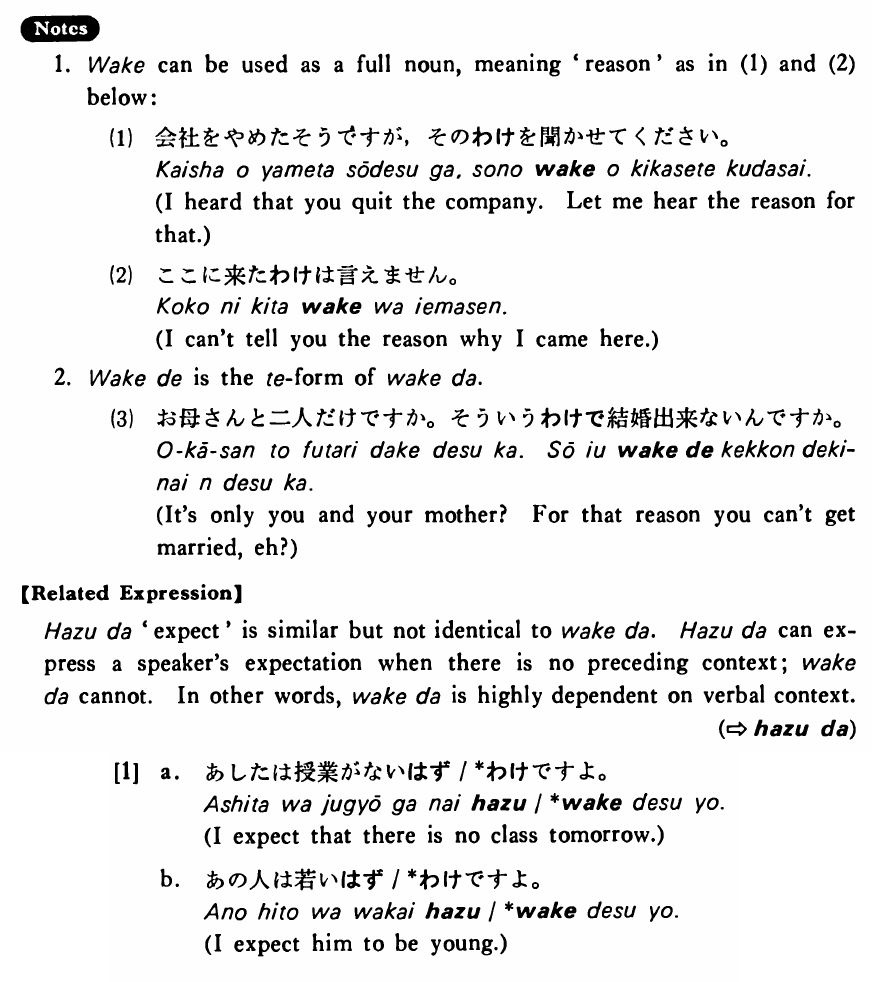
1. わけ can be used as a full noun, meaning reason as in (1) and (2) below:
2. わけで is the て form of わけだ.
【Related Expression】
はずだ 'expect' is similar but not identical to わけだ. はずだ can express a speaker's expectation when there is no preceding context; わけだ cannot. In other words, わけだ is highly dependent on verbal context.
(⇨ はずだ)
[1]